

Welcome to this ‘Mediation Quick Tips’ Newsletter Issue 12
Safe Challenging Questions
It has been some time since I last sent you a #MediationQuickTips Newsletter and for this I do apologise. I have been concentrating on writing the 2nd Edition of ‘The Mediator’s Toolkit: Formulating and Asking Questions for Successful Outcomes’ and it will be published on 10th June 2025 and can be pre-ordered on amazon.com or waterstones.com or other well known sites.
This article, along with the following shorter ones, will provide you with brief and straightforward #MediationQuickTips on the mediation framework, approach, process, skills and language necessary to ask difficult questions in a gentle, yet purposeful, manner. I will continue to write about these tips, in bite-size pieces, in future newsletters.
In this series of #MediationQuickTips, I’ll be guiding you through the essential elements of asking challenging mediation questions, in a safe way. This newsletter and the upcoming editions will give you practical, straightforward tips on the framework, approach, process, and skills needed to ask tough questions — while maintaining a gentle yet purposeful tone.
Stay tuned for future newsletters, where I’ll continue to share bite-sized, actionable tips that will empower you to mediate with clarity and compassion.
NOTE!
The 2nd Edition of ‘The Mediator’s Toolkit: Formulating and Asking Questions for Successful Outcomes’, published 10th June 2025 can be ordered on amazon.com or waterstones.com or on amazon.co.uk and other well known websites.
Next O’Sullivan Solutions online advanced mediation courses:
15, 16, 22, 23, October 2026
Time Schedule for all advanced mediation courses:
Irish Standard Time: / GMT: 1.30pm -5.30pm
Four half days – Live zoom course
advanced level mediator training
Worried about asking Challenging Questions?
One of the most critical aspects of mediation is creating an environment where all parties feel safe to engage and respond thoughtfully. In this issue I am starting with some key tips on the mediation framework and the essential mediator’s approach to use when asking questions. These should underpin any communicatons you have with parties in conflict.
1. Beware the Amygdala!
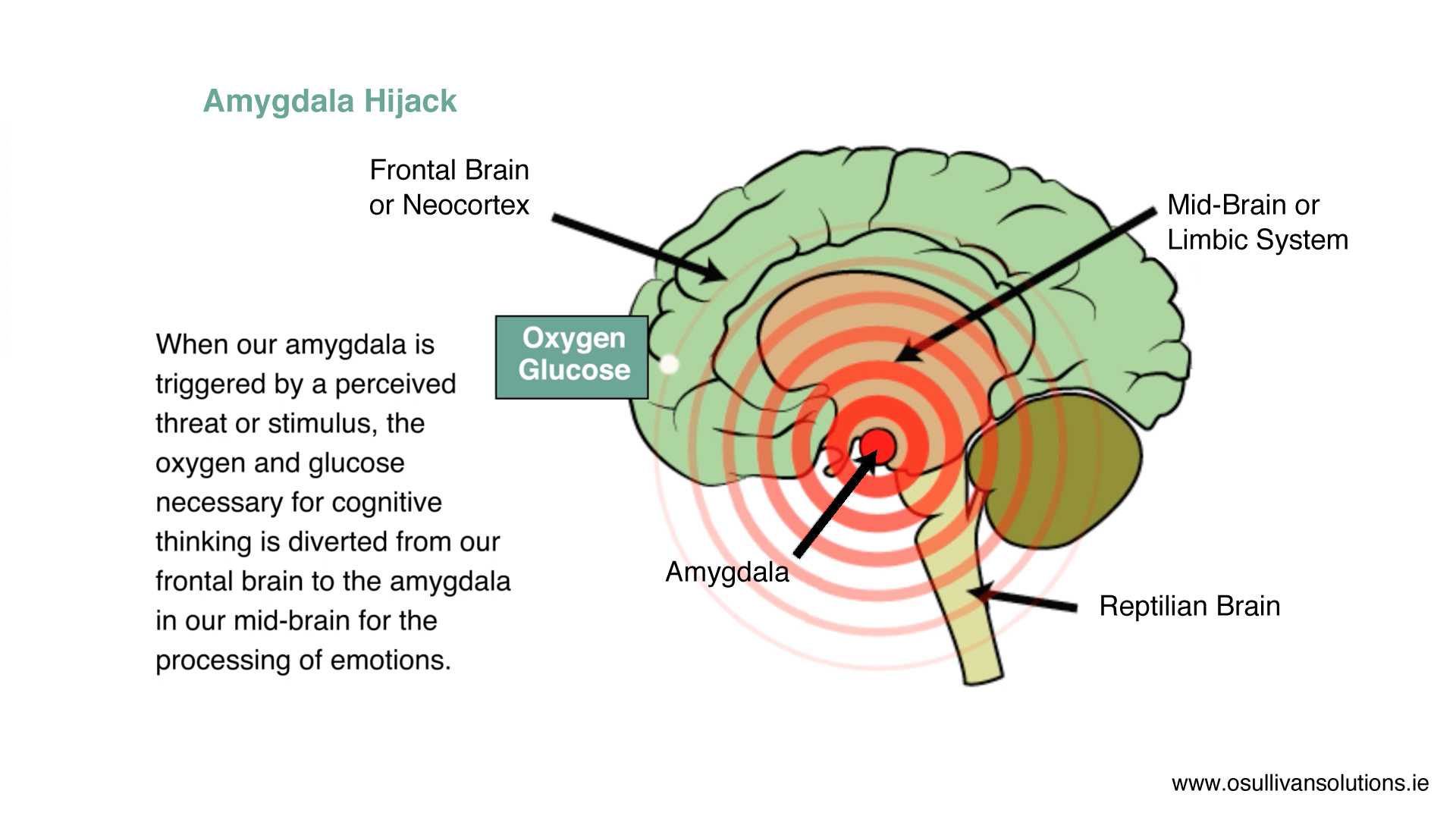
I have referred to the function of the amygdala in previous newsletters but it is important to mention it again as we need to work with the knowledge of the function of the amygdala and not ask questions that could result in a party feeling vulnerable or under threat as this could inadvertently trigger an amygdala hijack and they may not be able to think clearly or logically.
Refer to #MediationQuickTips Newsletters – Issues 1, 2, and 3 – for more information on emotions and the role of the amygdala in our limbic system.
Refer to Chapter 3 in The Mediator’s Toolkit: Formulating and Asking Questions for Successful Outcomes.
2. Mediation Framework
As stated in my book The Mediator’s Toolkit: Formulating and Asking Questions for Successful Outcomes, the ‘S Questions Model’ is designed on the premise that an initial separate and private meeting will take place with each of the parties prior to bringing them together for a joint meeting, and that separate (caucus) meetings are part of the structure of the joint meeting, if necessary, and appropriate to the needs of the process and the parties.
Hold Separate Private Meetings
Parties in conflict need to build trust with their mediator prior to being in a room with the other party. Holding an initial separate meeting creates a space for this to happen. To do otherwise heightens the level of threat that parties coming to a joint meeting may feel, and this could be aggravated by a mediator who, because they are working in a vacuum of knowledge about the parties, could inadvertently ask questions that could stimulate an unnecessary avoid-threat reflex in the parties.
Refer to #MediationQuickTips Newsletters – Issue 5 – for comprehensive information on preparing for and holding private meetings.
This initial separate meeting can last between one hour and two and a half hours for each party. The Opening Statement needs to include a description of how the mediation process is going to work, and it also needs to outline some of the ways that will empower parties and protect their safety and vulnerability.
Example:
- Tell parties that mediation is voluntary and that they may leave if they wish, at any time before or during the process
- Let mediation participants know that they do not have to respond to your questions
- Ask parties for permission when asking a “hard” question
- Give parties permission to challenge you if they think you are being partial
Be more process driven than outcome driven when you are listening, keeping a participant on their Thought-Flow-Track, hearing inferences and assumptions or exploring underlying interests. As trust is built and people have had an opportunity to air their issues, you will be able to ask more exploratory or challenging questions, safely.
Refer to #MediationQuickTips Newsletters – Issue 10 – for a description of Thought-Flow-Tracking
A separate meeting can create a forum where discussion can take place about issues that may be sensitive for a party or that could result in them becoming vulnerable in front of the other party. Some of the deeper and more searching questions that are contained in the S4: Shift Thinking questions from the ‘S Questions Model’ need to be initially asked and tested at this separate meeting to judge how safe it would be to ask them at a joint meeting. It is important that a party is not inadvertently asked a question at a joint meeting that may result in them losing face or feeling threatened.
3. The Mediator’s Body Language
There are two fundamental things people are looking for in any relationship:
“Do I matter?” and “Am I heard?”
Jane Gunn, Corporate Peacemakers
Body Language
The meaning and intention behind what a mediator says is conveyed through their body language, their tone of voice, and the words that they verbalize. These three elements need to be congruent with each other. If not, the receiver of the message will be more influenced by what is conveyed through the nonverbal body language used, rather than by the words used. If the body language is threatening or judgmental, then this negativity is what will be understood. Parties will not feel that they matter and are heard and may feel vulnerable and become defensive with their responses.

Albert Mehrabian, Professor Emeritus of Psychology, UCLA, has become best known for his publications on the relative percentage importance of verbal and nonverbal messages. Mehrabian’s theory is that the type of body language and tone of voice used by a person conveys the intention of their message more than the actual words they use.
When a mediator is listening to parties and asking questions, the body language they display needs to convey respect and impartiality or multi-partiality, accompanied by an open body language stance and gentle eye contact. Forming eye contact does not mean staring eyeball to eyeball, but looking at the general triangle formed by the eyebrows and the mouth. Mediators need to imagine themselves as a blank sheet of paper waiting to be filled with information from the parties, and even a bit like the TV character detective Colombo, who asked his questions in an apparently charming, innocent manner. His body language was reflective, tentative, gentle, and curious.
Next Newsletter
Next time I will write about the criteria for judging if your question is safe and how to judge if the timing is right for asking a challenging question.
NOTE!
The 2nd Edition of ‘The Mediator’s Toolkit: Formulating and Asking Questions for Successful Outcomes’, published 10th June 2025 can be ordered on amazon.com or waterstones.com or on amazon.co.uk and other well known websites.
Next O’Sullivan Solutions online advanced mediation courses:
15, 16, 22, 23, October 2026
Time Schedule for all advanced mediation courses:
Irish Standard Time: / GMT: 1.30pm -5.30pm
Four half days – Live zoom course
advanced level mediator training

